|
On-Line Encyclopedia Of Integer Sequences
The On-Line Encyclopedia of Integer Sequences (OEIS) is an online database of integer sequences. It was created and maintained by Neil Sloane while researching at AT&T Labs. He transferred the intellectual property and hosting of the OEIS to the OEIS Foundation in 2009, and is its chairman. OEIS records information on integer sequences of interest to both professional and amateur mathematicians, and is widely cited. , it contains over 370,000 sequences, and is growing by approximately 30 entries per day. Each entry contains the leading terms of the sequence, keywords, mathematical motivations, literature links, and more, including the option to generate a graph or play a musical representation of the sequence. The database is searchable by keyword, by subsequence, or by any of 16 fields. There is also an advanced search function called SuperSeeker which runs a large number of different algorithms to identify sequences related to the input. History Neil Sloane started col ... [...More Info...] [...Related Items...] OR: [Wikipedia] [Google] [Baidu] [Amazon] |
Neil Sloane
__NOTOC__ Neil James Alexander Sloane FLSW (born October 10, 1939) is a British-American mathematician. His major contributions are in the fields of combinatorics, error-correcting codes, and sphere packing. Sloane is best known for being the creator and maintainer of the On-Line Encyclopedia of Integer Sequences (OEIS). Biography Sloane was born in Beaumaris, Anglesey, Wales, in 1939, moving to Cowes, Isle of Wight, England in 1946. The family emigrated to Australia, arriving at the start of 1949. Sloane then moved from Melbourne to the United States in 1961. He studied at Cornell University under Nick DeClaris, Frank Rosenblatt, Frederick Jelinek and Wolfgang Heinrich Johannes Fuchs, receiving his Ph.D. in 1967. His doctoral dissertation was titled ''Lengths of Cycle Times in Random Neural Networks''. Sloane joined Bell Labs in 1968 and retired from its successor AT&T Labs in 2012. He became an AT&T Fellow in 1998. He is also a Fellow of the Learned Society of Wales, an ... [...More Info...] [...Related Items...] OR: [Wikipedia] [Google] [Baidu] [Amazon] |
OEIS Banner
The On-Line Encyclopedia of Integer Sequences (OEIS) is an online database of integer sequences. It was created and maintained by Neil Sloane while researching at AT&T Labs. He transferred the intellectual property and hosting of the OEIS to the OEIS Foundation in 2009, and is its chairman. OEIS records information on integer sequences of interest to both professional and List of amateur mathematicians, amateur mathematicians, and is widely cited. , it contains over 370,000 sequences, and is growing by approximately 30 entries per day. Each entry contains the leading terms of the sequence, Keyword (computer programming), keywords, mathematical motivations, literature links, and more, including the option to generate a Graph of a function, graph or play a Computer music, musical representation of the sequence. The database is Search engine (computing), searchable by keyword, by subsequence, or by any of 16 fields. There is also an advanced search function called SuperSeeker whic ... [...More Info...] [...Related Items...] OR: [Wikipedia] [Google] [Baidu] [Amazon] |
Decimal
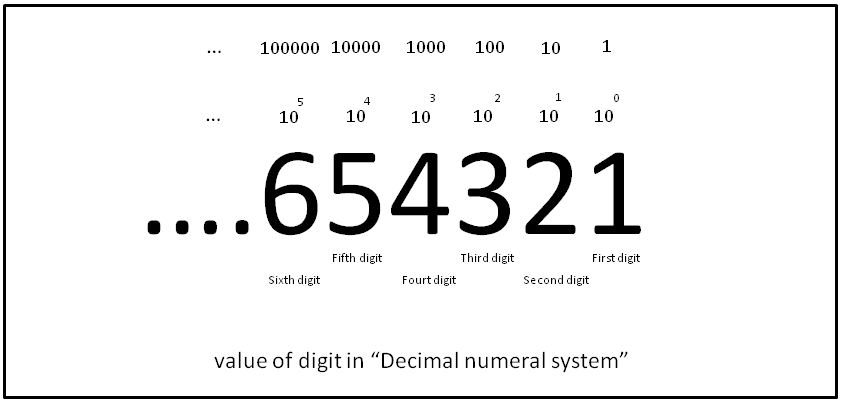
The decimal numeral system (also called the base-ten positional numeral system and denary or decanary) is the standard system for denoting integer and non-integer numbers. It is the extension to non-integer numbers (''decimal fractions'') of the Hindu–Arabic numeral system. The way of denoting numbers in the decimal system is often referred to as ''decimal notation''. A decimal numeral (also often just ''decimal'' or, less correctly, ''decimal number''), refers generally to the notation of a number in the decimal numeral system. Decimals may sometimes be identified by a decimal separator (usually "." or "," as in or ). ''Decimal'' may also refer specifically to the digits after the decimal separator, such as in " is the approximation of to ''two decimals''". Zero-digits after a decimal separator serve the purpose of signifying the precision of a value. The numbers that may be represented in the decimal system are the decimal fractions. That is, fractions of the form , w ... [...More Info...] [...Related Items...] OR: [Wikipedia] [Google] [Baidu] [Amazon] |
Irrational Number
In mathematics, the irrational numbers are all the real numbers that are not rational numbers. That is, irrational numbers cannot be expressed as the ratio of two integers. When the ratio of lengths of two line segments is an irrational number, the line segments are also described as being '' incommensurable'', meaning that they share no "measure" in common, that is, there is no length ("the measure"), no matter how short, that could be used to express the lengths of both of the two given segments as integer multiples of itself. Among irrational numbers are the ratio of a circle's circumference to its diameter, Euler's number ''e'', the golden ratio ''φ'', and the square root of two. In fact, all square roots of natural numbers, other than of perfect squares, are irrational. Like all real numbers, irrational numbers can be expressed in positional notation, notably as a decimal number. In the case of irrational numbers, the decimal expansion does not terminate, nor end ... [...More Info...] [...Related Items...] OR: [Wikipedia] [Google] [Baidu] [Amazon] |
Farey Sequence
In mathematics, the Farey sequence of order ''n'' is the sequence of completely reduced fractions, either between 0 and 1, or without this restriction, which have denominators less than or equal to ''n'', arranged in order of increasing size. With the restricted definition, each Farey sequence starts with the value 0, denoted by the fraction , and ends with the value 1, denoted by the fraction (although some authors omit these terms). A ''Farey sequence'' is sometimes called a Farey series (mathematics), ''series'', which is not strictly correct, because the terms are not summed. Examples The Farey sequences of orders 1 to 8 are : :''F''1 = :''F''2 = :''F''3 = :''F''4 = :''F''5 = :''F''6 = :''F''7 = :''F''8 = Farey sunburst Plotting the numerators versus the denominators of a Farey sequence gives a shape like the one to the right, shown for Reflecting this shape around the diagonal and main axes generates the ''Farey sunburst'', shown below. The Farey sunburst ... [...More Info...] [...Related Items...] OR: [Wikipedia] [Google] [Baidu] [Amazon] |
Complex Number
In mathematics, a complex number is an element of a number system that extends the real numbers with a specific element denoted , called the imaginary unit and satisfying the equation i^= -1; every complex number can be expressed in the form a + bi, where and are real numbers. Because no real number satisfies the above equation, was called an imaginary number by René Descartes. For the complex number is called the , and is called the . The set of complex numbers is denoted by either of the symbols \mathbb C or . Despite the historical nomenclature, "imaginary" complex numbers have a mathematical existence as firm as that of the real numbers, and they are fundamental tools in the scientific description of the natural world. Complex numbers allow solutions to all polynomial equations, even those that have no solutions in real numbers. More precisely, the fundamental theorem of algebra asserts that every non-constant polynomial equation with real or complex coefficie ... [...More Info...] [...Related Items...] OR: [Wikipedia] [Google] [Baidu] [Amazon] |
Transcendental Number
In mathematics, a transcendental number is a real or complex number that is not algebraic: that is, not the root of a non-zero polynomial with integer (or, equivalently, rational) coefficients. The best-known transcendental numbers are and . The quality of a number being transcendental is called transcendence. Though only a few classes of transcendental numbers are known, partly because it can be extremely difficult to show that a given number is transcendental. Transcendental numbers are not rare: indeed, almost all real and complex numbers are transcendental, since the algebraic numbers form a countable set, while the set of real numbers and the set of complex numbers are both uncountable sets, and therefore larger than any countable set. All transcendental real numbers (also known as real transcendental numbers or transcendental irrational numbers) are irrational numbers, since all rational numbers are algebraic. The converse is not true: Not all irrational numbers are ... [...More Info...] [...Related Items...] OR: [Wikipedia] [Google] [Baidu] [Amazon] |
Fraction
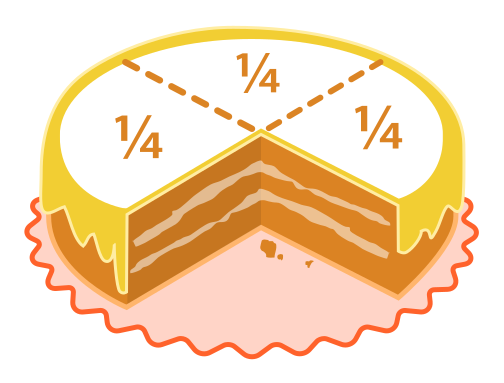
A fraction (from , "broken") represents a part of a whole or, more generally, any number of equal parts. When spoken in everyday English, a fraction describes how many parts of a certain size there are, for example, one-half, eight-fifths, three-quarters. A ''common'', ''vulgar'', or ''simple'' fraction (examples: and ) consists of an integer numerator, displayed above a line (or before a slash like ), and a division by zero, non-zero integer denominator, displayed below (or after) that line. If these integers are positive, then the numerator represents a number of equal parts, and the denominator indicates how many of those parts make up a unit or a whole. For example, in the fraction , the numerator 3 indicates that the fraction represents 3 equal parts, and the denominator 4 indicates that 4 parts make up a whole. The picture to the right illustrates of a cake. Fractions can be used to represent ratios and division (mathematics), division. Thus the fraction can be used to ... [...More Info...] [...Related Items...] OR: [Wikipedia] [Google] [Baidu] [Amazon] |
Charles Greathouse
Charles is a masculine given name predominantly found in English and French speaking countries. It is from the French form ''Charles'' of the Proto-Germanic name (in runic alphabet) or ''*karilaz'' (in Latin alphabet), whose meaning was "free man". The Old English descendant of this word was '' Ċearl'' or ''Ċeorl'', as the name of King Cearl of Mercia, that disappeared after the Norman conquest of England. The name was notably borne by Charlemagne (Charles the Great), and was at the time Latinized as ''Karolus'' (as in ''Vita Karoli Magni''), later also as '' Carolus''. Etymology The name's etymology is a Common Germanic noun ''*karilaz'' meaning "free man", which survives in English as churl (James (wikt:Appendix:Proto-Indo-European/ǵerh₂-">ĝer-, where the ĝ is a palatal consonant, meaning "to rub; to be old; grain." An old man has been worn away and is now grey with age. In some Slavic languages, the name ''Drago (given name), Drago'' (and variants: ''Dragom ... [...More Info...] [...Related Items...] OR: [Wikipedia] [Google] [Baidu] [Amazon] |
Ishango Bone
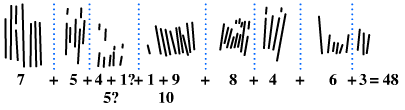
The Ishango bone, discovered at the "Fisherman Settlement" of Ishango in the Democratic Republic of the Congo, is a bone tool and possible mathematical device that dates to the Upper Paleolithic era. The curved bone is dark brown in color, about 10 centimeters in length, and features a sharp piece of quartz affixed to one end, perhaps for engraving. Because the bone has been narrowed, scraped, polished, and engraved to a certain extent, it is no longer possible to determine what animal the bone belonged to, although it is assumed to have been a mammal.Association pour la diffusion de l'information archéologique/Royal Belgian Institute of Natural Sciences, Brussels (n.d.). "Have You Heard of Ishango?" (PDF). ''Natural Sciences''. The ordered engravings have led many to speculate the meaning behind these marks, including interpretations like mathematical significance or astrological relevance. It is thought by some to be a tally stick, as it features a series of what has been in ... [...More Info...] [...Related Items...] OR: [Wikipedia] [Google] [Baidu] [Amazon] |
Journal Of Integer Sequences
The ''Journal of Integer Sequences'' is a peer-reviewed open-access academic journal in mathematics, specializing in research papers about integer sequences. It was founded in 1998 by Neil Sloane. Sloane had previously published two books on integer sequences, and in 1996 he founded the On-Line Encyclopedia of Integer Sequences (OEIS). Needing an outlet for research papers concerning the sequences he was collecting in the OEIS, he founded the journal. Since 2002 the journal has been hosted by the David R. Cheriton School of Computer Science at the University of Waterloo, with Waterloo professor Jeffrey Shallit as its editor-in-chief. There are no page charges for authors, and all papers are free to all readers. The journal publishes approximately 50–75 papers annually.. In most years from 1999 to 2014, SCImago Journal Rank has ranked the ''Journal of Integer Sequences'' as a third-quartile journal in discrete mathematics and combinatorics. It is indexed by ''Mathematical Review ... [...More Info...] [...Related Items...] OR: [Wikipedia] [Google] [Baidu] [Amazon] |
Email
Electronic mail (usually shortened to email; alternatively hyphenated e-mail) is a method of transmitting and receiving Digital media, digital messages using electronics, electronic devices over a computer network. It was conceived in the late–20th century as the digital version of, or counterpart to, mail (hence ''wikt:e-#Etymology 2, e- + mail''). Email is a ubiquitous and very widely used communication medium; in current use, an email address is often treated as a basic and necessary part of many processes in business, commerce, government, education, entertainment, and other spheres of daily life in most countries. Email operates across computer networks, primarily the Internet access, Internet, and also local area networks. Today's email systems are based on a store-and-forward model. Email Server (computing), servers accept, forward, deliver, and store messages. Neither the users nor their computers are required to be online simultaneously; they need to connect, ty ... [...More Info...] [...Related Items...] OR: [Wikipedia] [Google] [Baidu] [Amazon] |