|
Loch Lomond And The Trossachs National Park
Loch Lomond and The Trossachs National Park () is a national park in Scotland centred on Loch Lomond and the hills and glens of the Trossachs, along with several other ranges of hills. It was the first of the national parks of Scotland, two national parks established by the Scottish Parliament in 2002, the second being the Cairngorms National Park. The park extends to cover much of the western part of the southern Highlands of Scotland, highlands, lying to the north of the Glasgow conurbation, and contains many mountains and lochs. It is the fourth-largest national park in the British Isles, with a total area of and a boundary of some in length. It features 21 Munros (including Ben Lomond, Ben Lui, Beinn Challuim, Ben More (Crianlarich), Ben More and two peaks called Ben Vorlich (Loch Lomond), Ben Vorlich) and 20 Hill lists in the British Isles, Corbetts. The park straddles the Highland Boundary Fault, which divides it into two distinct regions - lowland and highland - that dif ... [...More Info...] [...Related Items...] OR: [Wikipedia] [Google] [Baidu] [Amazon] |
Loch Katrine
Loch Katrine (; or ) is a freshwater loch in the Trossachs area of the Scottish Highlands, east of Loch Lomond within the Stirling (council area), Stirling council area. It mostly lies within the Shires of Scotland, historic and registration county of Perthshire, with Glengyle Water and the northern part of the loch's mid-line forming part of the boundary with historic Stirlingshire. The loch is about long and wide at its widest point, and runs the length of Strath Gartney (Gaelic: ). It is within the drainage basins of the River Teith and River Forth. It is a popular scenic attraction for tourists and day-visitors from Glasgow and nearby towns; Fly fishing, fly and boat fishing for trout are permitted on the loch from spring to autumn. It also serves as a reservoir for the water supply of the Glasgow conurbation, some south, being connected by two aqueducts constructed in 1859. It is the fictional setting of Sir Walter Scott's poem ''The Lady of the Lake (poem), The Lady o ... [...More Info...] [...Related Items...] OR: [Wikipedia] [Google] [Baidu] [Amazon] |
Ben More (Crianlarich)
Ben More (, "the great mountain") is a mountain in the Breadalbane region of the southern Scottish Highlands, near Crianlarich. Rising to , it is a Munro and is the highest of the so-called Crianlarich Hills to the south-east of the village. There is no higher land in the British Isles south of Ben More. It is separated from () by the ', " col between two mountains". It is the highest peak in the Loch Lomond and The Trossachs National Park. Ben More's north side contains a long-lasting snow patch, which – uniquely in the Southern Highlands – is named on a 1:25000 Ordnance Survey map, and is called the ' (crooked wreath), on account of the shape it forms in late spring/early summer. This patch frequently lasts until well into June and sometimes July. The similar name ' appears as a summit near Lochnagar. Climbing The simplest ascent starts from Benmore Farm on the A85. Initially, one should follow the path leading up Benmore Burn, before leaving this path and heading u ... [...More Info...] [...Related Items...] OR: [Wikipedia] [Google] [Baidu] [Amazon] |
Ordnance Survey
The Ordnance Survey (OS) is the national mapping agency for Great Britain. The agency's name indicates its original military purpose (see Artillery, ordnance and surveying), which was to map Scotland in the wake of the Jacobite rising of 1745. There was also a more general and nationwide need in light of the potential threat of invasion during the Napoleonic Wars. Since 1 April 2015, the Ordnance Survey has operated as Ordnance Survey Ltd, a state-owned enterprise, government-owned company, 100% in public ownership. The Ordnance Survey Board remains accountable to the Secretary of State for Science, Innovation and Technology. It was also a member of the Public Data Group. Paper maps represent only 5% of the company's annual revenue. It produces digital map data, online route planning and sharing services and mobile apps, plus many other location-based products for business, government and consumers. Ordnance Survey mapping is usually classified as either "Scale (map), lar ... [...More Info...] [...Related Items...] OR: [Wikipedia] [Google] [Baidu] [Amazon] |
Cowal
Cowal () is a rugged peninsula in Argyll and Bute, on the west coast of Scotland. It is connected to the mainland to the north, and is bounded by Loch Fyne to the west, by Loch Long and the Firth of Clyde to the east, and by the Kyles of Bute to the south. Argyll is the historic county that the Cowal peninsula was within. Inveraray was the county town. The northern part of the peninsula is covered by Argyll Forest Park and also includes the Arrochar Alps. In the south, the peninsula is divided into three forks by Loch Striven and Loch Riddon. Cowal's only burgh is Dunoon in the south-east, from which ferries sail to Gourock in Inverclyde. Other ferries run from Portavadie in the west to Tarbert in Kintyre, and from Colintraive in the south to Rhubodach on Bute. Much of Cowal was once held by the Lamont clan. Later, the Campbells came to be one of the most powerful families in Cowal. The highest point on the peninsula is Beinn an Lochain in the Arrochar Alps, a ... [...More Info...] [...Related Items...] OR: [Wikipedia] [Google] [Baidu] [Amazon] |
Breadalbane, Scotland
Breadalbane (; , meaning "upper Alba" or "upland of Alba") is a region of the southern/central Scottish Highlands, within the Grampian Mountains range. It is a mountainous region comprising the watershed of Loch Tay; its boundaries are roughly the West Highland Way in the west, Rannoch Moor in the northwest, Loch Rannoch in the north, the River Tummel in the east, the Highland boundary in the southeast, and Loch Earn and Loch Voil- Loch Doine in the south. The former Breadalbane district was surrounded by the districts of Atholl, Strathearn, Menteith, The Lennox, Argyll and Lochaber. The Breadalbane Hydro-Electric Scheme lies within the region. The ''Atholl and Breadalbane Gathering'' is a popular 2/4 March tune for the Great Highland Bagpipes. History 350px, A 1689 map, showing the borders of Breadalbane as a distinct Province (in blue, at the centre of the map, as "broad alba-in") Breadalbane formed one of the traditional provinces of Scotland, surrounded by Ath ... [...More Info...] [...Related Items...] OR: [Wikipedia] [Google] [Baidu] [Amazon] |
Loch Lomond From The Slopes Of Ben Lomond
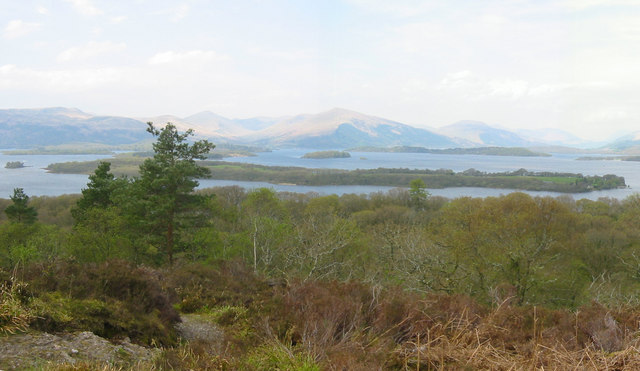
''Loch'' ( ) is a word meaning "lake" or " sea inlet" in Scottish and Irish Gaelic, subsequently borrowed into English. In Irish contexts, it often appears in the anglicized form "lough". A small loch is sometimes called a lochan. Lochs which connect to the sea may be called "sea lochs" or "sea loughs". Background This name for a body of water is Insular CelticThe current form has currency in the following languages: Scottish Gaelic, Irish, Manx, and has been borrowed into Lowland Scots, Scottish English, Irish English and Standard English. in origin and is applied to most lakes in Scotland and to many sea inlets in the west and north of Scotland. Many of the loughs in Northern England have also previously been called "meres" (a Northern English dialect word for "lake", and an archaic Standard English word meaning "a lake that is broad in relation to its depth"), similar to the Dutch , such as the ''Black Lough'' in Northumberland. Some lochs in Southern Scotland ha ... [...More Info...] [...Related Items...] OR: [Wikipedia] [Google] [Baidu] [Amazon] |
Central Belt
The Central Belt of Scotland is the Demographics of Scotland, area of highest population density within Scotland. Depending on the definition used, it has a population of between 2.4 and 4.2 million (the country's total was around 5.4 million in 2019), including multiple List of towns and cities in Scotland by population, major Scottish settlements such as Paisley, Renfrewshire, Paisley, Glasgow, East Kilbride, Livingston, West Lothian, Livingston, and Edinburgh. Despite the name, it is not geographically central but is nevertheless at the "waist" of Scotland on a conventional map and the term "central" is used in many Subdivisions of Scotland, local government, police, and NGO designations. It was formerly known as the Midlands or Scottish Midlands, but this term has fallen out of fashion. The Central Belt lies between the Scottish Highlands, Highlands to the north and the Southern Uplands to the south. In the early 21st century, predictions were made that due to economic mi ... [...More Info...] [...Related Items...] OR: [Wikipedia] [Google] [Baidu] [Amazon] |
Conic Hill
Conic Hill (from Gaelic "còinneach" meaning moss) is a prominent hill in Stirling, Scotland. Location and description It is on the east bank of Loch Lomond, beside the village of Balmaha. It is a sharp little summit which is on the Highland Boundary Fault. There was a tiny cairn at the top (); there is only a scattering of stones to mark the "true" summit.''Conic Hill'' at www.hill-bagging.co.uk. Retrieved 25 May 2017. Most visitors also stop on a sub-summit at . Views From the top, it offers impressive views over Loch Lomond and towards ; on a clear day it is even possible to see Goat Fell on[...More Info...] [...Related Items...] OR: [Wikipedia] [Google] [Baidu] [Amazon] |
Inchcailloch
Inchcailloch () is an islet on Loch Lomond in Scotland. It is at its highest point. It is also known to some as Inchebroida. The name Inchcailloch means "Isle of the old woman" or "Isle of the Cowled (Hooded) Woman" in the Scottish Gaelic language. Saint Kentigerna went to Scotland from Ireland to preach and spread Christianity and the island is thought to be named after her. Geography and geology Inchmurrin, Creinch, Torrinch, and Inchcailloch all form part of the Highland boundary fault. There is a burial ground in the north of the island, and a bay, Port Bawn (; ), in the south. Like many of the Loch Lomond islands, it is quite heavily wooded. Transport There is a passenger ferry across the short channel separating it from Balmaha on the mainland. As a result, it receives more visitors than most of the Loch Lomond islands, currently 20,000 visitors per year. There is a camp site in the south at Port Bawn and a nature trail. History Inchcailloch has been used as ... [...More Info...] [...Related Items...] OR: [Wikipedia] [Google] [Baidu] [Amazon] |
Torrinch
Torrinch or Inchtore () is a wooded island in Loch Lomond in Scotland. The name Torremach is also recorded for it.Wilson, Rev. John ''The Gazetteer of Scotland'' (Edinburgh, 1882) Published by W. & A.K. Johnstone Geography It is one of the smaller islands in the loch. Torrinch, along with Inchmurrin, Creinch, and Inchcailloch, forms part of the Highland Boundary Fault.Worsley, Harry ''Loch Lomond: The Loch, the Lairds and the Legends'' Lindsay Publications (Glasgow) 1988 In the 1800s it was covered with oaks.Garnett, T. (1800). ''Observations on a Tour of the Highlands'' ... London. V.1. p. 40. It lies just to the south-west of the larger island of Inchcailloch Inchcailloch () is an islet on Loch Lomond in Scotland. It is at its highest point. It is also known to some as Inchebroida. The name Inchcailloch means "Isle of the old woman" or "Isle of the Cowled (Hooded) Woman" in the Scottish Gaelic ..., and north-east of Creinch. Footnotes External links short ar ... [...More Info...] [...Related Items...] OR: [Wikipedia] [Google] [Baidu] [Amazon] |
Creinch
Creinch (, Tree Island) is an island on the Highland Boundary Fault in Loch Lomond Loch Lomond (; ) is a freshwater Scottish loch which crosses the Highland Boundary Fault (HBF), often considered the boundary between the lowlands of Central Scotland and the Highlands.Tom Weir. ''The Scottish Lochs''. pp. 33-43. Published by .... History Formerly Inchcroin (not to be confused with Inchcruin), Creinch lies a little north of Inchmurrin.Wilson, Rev. John ''The Gazetteer of Scotland'' (Edinburgh, 1882) Published by W. & A.K. Johnstone Inchcailloch, Torrinch, Creinch and Inchmurrin form part of the Highland boundary fault.Worsley, Harry ''Loch Lomond: The Loch, the Lairds and the Legends'' Lindsay Publications (Glasgow) 1988 In 1800 Garnett referred to the island as 'Grange'. Wildlife As the Gaelic name implies, it is completely covered in ivy draped trees, including some wych elms. In summer it can be difficult to penetrate the interior and in spring, it is carpeted i ... [...More Info...] [...Related Items...] OR: [Wikipedia] [Google] [Baidu] [Amazon] |
Inchmurrin
Inchmurrin () is an island in Loch Lomond in Scotland. It is the largest lake island, fresh water island in the British Isles. Geography and geology Inchmurrin is the largest and most southerly of the islands in Loch Lomond. It reaches a height of towards the north and is largely wooded. There is an excellent view of the north end of the loch. Along with Creinch, Torrinch, and Inchcailloch, Inchmurrin forms part of the Highland boundary fault. History Inchmurrin was the site of a 7th-century monastery, with a chapel dedicated to Saint Mirin, after whom it was named. The island was formerly a deer park of the Duke of Montrose, Dukes of Montrose, who had a hunting lodge built in 1793 and maintained a gamekeeper and his family there. 200 deer are recorded in 1800. There are ruins of a castle, probably built for Duncan, 8th Earl of Lennox whose seat was Balloch Castle (West Dunbartonshire), Balloch Castle at the south end of Loch Lomond. The castle was probably a hunting ... [...More Info...] [...Related Items...] OR: [Wikipedia] [Google] [Baidu] [Amazon] |